



 (902)442-8853
 CALL US
 EMAIL US

Long-term disability (LTD) claims are often assessed based on medical evidence, but one of the most important, yet frequently overlooked, factors is how the policy defines disability. Many people assume that a serious diagnosis is enough to qualify for benefits. In reality, entitlement to LTD benefits also depends on how the condition affects a person’s ability to work under the policy’s specific terms.
Many LTD policies apply different definitions of disability at different stages of a claim. Early on, eligibility is often assessed under an ‘own occupation’ definition. Later, the policy may shift to an ‘any occupation’ definition, which is generally harder to satisfy. These terms are central to how insurers evaluate both initial claims and ongoing eligibility.
Understanding the distinction between own occupation and any occupation is critical. The change between these definitions can significantly affect whether benefits continue or are terminated, even when a claimant’s medical condition has not improved.
Why Disability Definitions Matter in Long-Term Disability Claims
LTD benefits depend on more than a diagnosis. Insurers assess whether the condition prevents a claimant from performing work duties. This requires a connection between the medical impairment and the claimant’s functional work limitations.
Two individuals with the same diagnosis may be assessed differently depending on their occupational demands: a surgeon and an office-worker with similar wrist injuries may face different challenges at work and their benefits may vary in turn.
LTD policies use their own definitions to determine whether a claimant qualifies for benefits. The wording of the policy is crucial, as even small differences can significantly alter how eligibility is assessed.
Depending on the applicable definition, insurers may consider the claimant’s regular occupation or other occupations for which the claimant is reasonably suited.
Financial consequences of the definition applied
The definition of disability has direct financial implications. It affects:
- Initial approval of benefits
- Continued eligibility over time
- The likelihood of reassessment and termination
A claim approved under an ‘own occupation’ definition may be reassessed when the definition changes to ‘any occupation’. Whether and when that change occurs depends on the policy.
What Does “Own Occupation” Mean?
An ‘own occupation’ definition generally focuses on the claimant’s regular job when the disability began. Depending on the policy, the claimant must be unable to perform the essential or substantial duties of that occupation.
This does not necessarily require an inability to work in every capacity. A claimant may still be able to perform other types of work and qualify under this definition. Defining a disability package as ‘own occupation’ protects workers from having to seek work outside their technical skills and qualifications. This distinction can be important for workers with specialized skills or training.
What Insurers Typically Examine
When applying an ‘own occupation’ standard, insurers consider the demands of the claimant’s regular occupation, including:
- Responsibilities and daily tasks.
- Physical requirements (i.e, lifting, standing, or manual labour.)
- Cognitive demands (concentration, decision-making, and problem-solving.)
- Skilled or technical duties unique to the role.
The focus is on what the job actually requires, not simply the job title.
Examples of ‘Own Occupation’ Disability
- A surgeon who develops a hand tremor may be unable to perform surgical procedures, even if they can still do non-surgical work.
- A skilled-trade worker with a back injury may be unable to meet the physical demands of their trade.
- A social worker with a cognitive impairment may struggle with concentration, deadlines, decision-making, or interactions with clients.
In each example, the person might still be able to do other work, but not their regular occupation. An ‘own occupation’ definition is generally more favourable to claimants because it is narrowly focused. The assessment is limited to a specific role, making it easier to demonstrate how a medical condition prevents job performance.
What Is an ‘Any Occupation’ Definition?
An ‘any occupation’ definition shifts the focus away from the claimant’s previous job. Instead, it examines whether the individual claimant can perform other work falling within the policy’s definition. Being unable to return to a previous occupation may no longer be enough to qualify.
Commonly, policies specify that this transition occurs after 24 months, where after a re-evaluation, the claimant transitions to an ‘any occupation’ definition if they are still unable to perform the duties of their previous employment.
‘Any occupation’ does not necessarily mean literally any job. The policy may require consideration of work for which the claimant is reasonably suited for, based on factors such as:
- Education level
- Training and certifications
- Work experience
Some policies specify an earnings threshold for alternative work; others do not. A requirement for income comparable to the claimant’s job should not be assumed. Insurers may use vocational assessments to determine alternative employment options. Evaluation factors include:
- Analysis of transferable skills
- Review of past employment history
- Identification of potential occupations the claimant could perform
- Depending on the policy and the evidence, insurers may consider modified, light-duty, or sedentary roles.
Challenges and Misconceptions to ‘Any Occupation’ Benefit Claims
An ‘any occupation’ definition can often be harder to satisfy because it expands the range of work considered. There are several misunderstandings about this definition:
- It does not necessarily require the claimant to be incapable of performing any job
- It does not automatically make every entry-level or minimum-wage position suitable
- Its scope depends on the specific policy wording and the claimant’s circumstances
Side-by-Side Comparison of Own Occupation vs Any Occupation
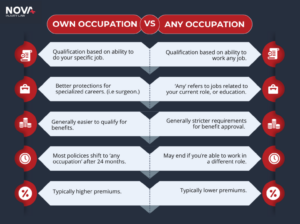
The ‘Own Occupation’ to ‘Any Occupation’ Timeline and Transition
Many LTD policies are structured in two phases:
- An initial ‘own occupation’ period; and
- A subsequent ‘any occupation’ period.
A common structure changes the definition after a 24-month ‘own occupation’ period following the elimination period, but some Nova Scotia plans provide different periods, including 30 months. The transition date depends on the policy or plan and should not be assumed to run from the date benefits were first paid.
A reassessment at that point may involve:
- Updated medical evidence about the inability to perform different work
- Evidence of functional limitations relevant to the new definition
- Vocational evidence about potentially suitable occupations
Even if a claimant’s condition has not improved, the change in definition alone may affect eligibility.
Common Outcomes After Reassessment
- Benefits may continue if the claimant meets the ‘any occupation’ definition and the policy’s other conditions.
- The insurer may request further medical or vocational information. Benefits may be suspended while information is outstanding, depending on the policy and circumstances.
- The insurer may terminate benefits if it determines that the claimant no longer meets the definition. That determination can be disputed.
How Insurers Assess Whether You Can Work in “Any Occupation”
| Evaluation Factors | Assessment | Purpose |
|---|---|---|
| Medical Evidence | Physician reports, specialist opinions, treatment history. | Insurers assess whether the medical evidence supports ongoing work limitations. |
| Functional Capacity | Physical restrictions (i.e mobility, strength,) cognitive limitations affecting concentration or memory, psychological factors such as anxiety or depression | These factors are evaluated to determine work capacity to better identify limitations and suitable alternatives. |
| Vocational Assessments | Review of employment history, assessment of education and qualifications, transferable skills analysis. | These assessments aim to identify realistic job alternatives that fit the claimant’s capabilities and background. |
| Alternative Occupations | Sedentary or light-duty positions, modified versions of previous work, or jobs within similar industries with less physical or cognitive demand. | To offer suitable work alternatives rather than the return to any work. (Often a point of dispute in disability claims.) |
Common Disputes After the Any Occupation Transition
- Claimants remain disabled but benefits stop: a claimant may still experience symptoms while the insurer concludes that suitable work is possible. This can lead to a dispute over eligibility.
- Disagreements over suitable occupations: claimants may challenge whether proposed jobs fit their restrictions, skills or experience, or meet an earnings threshold if the policy contains one.
- Conflicting medical opinions: differences between treating physicians and insurer-retained assessors can create significant conflict regarding functional capacity.
- Disputes regarding functional capacity, including:
- Physical limitations such as endurance or mobility
- Cognitive impairments affecting reliability
- Mental health limitations impacting work consistency
Evidence That Can Be Important When Challenging an ‘Any Occupation’ Decision
- Medical documentation
- Updated physician reports
- Specialist assessments
- Ongoing treatment records
- Evidence of daily limitations:
- Documentation of work restrictions
- Descriptions of day-to-day challenges
- Vocational evidence
- Vocational reports may help assess whether proposed jobs fit the claimant’s abilities, education, training, and work experience.
- Ongoing documentation
- Consistent medical follow-up helps support continued eligibility by documenting ongoing symptoms, treatment and restrictions.
Questions Policyholders Should Review in Their LTD Policy
- How is disability defined in the policy?
- When does the ‘own occupation’ period end?
- How does the policy define ‘any occupation’?
- Does the policy set an earnings threshold or other conditions for alternative work?
- Are there other eligibility requirements, exclusions or limitations?
Understanding these details can help anticipate how a claim will be evaluated over time.
Final Thoughts
The distinction between ‘own occupation’ and ‘any occupation’ definitions is an important factor in LTD claims. While many claimants initially qualify under the own occupation standard, where a policy uses both definitions, the later ‘any occupation’ test may be more difficult to meet.
The change may affect eligibility even if the claimant’s medical condition has not improved. As a result, understanding how these definitions operate and when they apply is essential for managing expectations and preparing for reassessment.
Ultimately, like most insurance disputes, the specific wording of the applicable LTD policy or plan, together with the claimant’s circumstances, governs the assessment for entitlement. Small differences in language can have major implications for benefits and long-term financial security.
For any questions or concerns regarding your LTD policy, we’re here to help. Contact us for a no-fee, no-obligation case review, we’re available 24/7!


