



 (902)442-8853
 CALL US
 EMAIL US
Corner Brook Rear-End Accident Lawyers
Rear-end collisions happen when one vehicle strikes another from behind. They are often associated with distracted driving, following too closely and failing to adjust to changing traffic conditions.
A rear-end collision can turn an ordinary drive through Corner Brook into a difficult and unexpected experience. Beyond vehicle damage, the impact can leave drivers and passengers coping with painful injuries, ongoing treatment and time away from work. Some injuries are not immediately obvious, making it important to pay attention to new or worsening symptoms in the days following a crash.
If another driver crashed into you, you do not have to face it alone. NOVA Injury Law helps injured people in Corner Brook and across Newfoundland understand their rights, deal with insurance companies, and pursue fair compensation.
Causes of How Rear-End Accidents in Newfoundland
Corner Brook’s winding roads and steep hills can create challenging driving conditions, particularly during poor weather or heavy traffic. In busy areas like downtown and around Memorial University campus, traffic can quickly become congested during rush hour. When a driver stops suddenly, those travelling behind them need enough time and space to react safely and avoid a collision.
Newfoundland winters create more risk. Snow, ice, and slush can double the distance a car needs to stop. A driver who follows too closely in bad weather may have no way out when traffic slows down.
Rear-end collisions in and around Corner Brook often trace back to a few common causes:
- Distracted driving: Looking at a phone or adjusting a GPS takes a driver’s eyes off the road.
- Following too closely: Drivers who tailgate cannot stop in time when the vehicle ahead brakes.
- Driving too fast for conditions: In fog, rain, or snow, a safe speed may be far below the posted limit.
- Sudden stops: Traffic near schools, shopping areas, and highway exits can slow without warning.
- Poor weather: Ice and wet snow reduce traction, especially on hills.
The results can be serious. Whiplash, back injuries, and concussions are common in rear-end impacts, and some do not show up until hours or days later.
Who Is at Fault When You Are Hit From Behind?
In Newfoundland and Labrador, responsibility for a rear-end collision generally depends on whether a driver failed to take reasonable care and whether their actions caused or contributed to the accident. Drivers are required to maintain a reasonable following distance, taking into account factors such as speed, traffic and road conditions. Although the rear driver is often responsible, the circumstances of each collision must be considered when determining fault.
Not every rear-end accident is straightforward – situations like a chain-reaction crash may involve several drivers sharing fault, a driver who reversed into you may be treated differently, and fault can be split in some situations.
Keep in mind: the insurance company’s fault decision is not the same as proving negligence in a lawsuit. For a personal injury claim, the evidence still matters. Police reports, photos, witness statements, and vehicle damage all help show what really happened.
How Section B Benefits Work in Newfoundland Motor Vehicle Accidents
Newfoundland and Labrador is different from every other Atlantic province in one important way: accident benefits, called Section B, are optional here. In Nova Scotia, New Brunswick, and PEI, they come standard. In this province, the coverage must be included in an applicable insurance policy for benefits to be available.
Check the applicable policy or contact an insurer to find out whether Section B benefits are available to you. Passengers may also qualify for benefits under the policy covering the vehicle they occupied. If you qualify, it can help early on, no matter who caused the crash:
- Medical and rehab costs: up to $25,000 for eligible expenses incurred within four years of the accident under standard coverage, or a higher monetary limit if provided by your policy, for things like physiotherapy and chiropractic care
- Income replacement: possible weekly payments if your accident injuries prevent you from working and you meet the policy’s eligibility requirements – the amount varies depending on your policy
- Funeral and death benefits: amounts payable to families after a fatal crash
Whiplash, sprain, and strain injuries also follow a set treatment schedule: Where the patient and healthcare provider choose to use the treatment protocols, they generally apply for up to 90 days, with limits of 10 or 21 treatment visits depending on the injuries involved. Additional treatment may still be approved where Section B coverage is available..
Under these protocols, a completed claim form generally must be submitted within 10 business days of the accident, although a different timeframe may apply where the insurer considers that deadline unreasonable. Insurers generally must approve or refuse a completed claim within five business days and pay qualifying treatment claims within 30 days of receiving them.
What You Can Claim From the At-Fault Driver
Section B may provide eligible benefits during your recovery, where coverage is available. A separate personal injury claim may be brought against a driver whose negligence caused your injuries.
A personal injury claim can include:
- Pain and suffering
- Lost income
- Future earning capacity
- Future care
- Housekeeping and assistance
Income-loss and earning-capacity damages are generally assessed on a net basis. Certain benefits already received or still available, including Section B payments, may also reduce the damages recoverable in a lawsuit.
Newfoundland and Labrador has no statutory cap on minor injury compensation. Rather, a $5,000 deductible comes off the pain-and-suffering part of your claim, no matter how serious your injuries are. The deductible never applies to your wage loss, treatment costs, or vehicle damage.
Can I File a Claim as a Passenger in a Collision?
Everything on this page applies to passengers too, with one advantage. Passengers are almost never responsible for the driving decisions that cause a crash. However, their compensation may still be reduced in certain circumstances. For example, failing to wear a required seat belt can result in a 25% reduction in damages unless the passenger establishes that it did not contribute to their injuries.
If you were riding in the front vehicle and were hurt when it was struck from behind, you may have a claim against the driver who struck your vehicle, the driver of the vehicle you were travelling in, or both, depending on whose negligence caused or contributed to your injuries.
Each injured person has a separate claim, so if you and the driver were both hurt by a negligent driver, your claims are assessed individually, even if they are pursued in the same lawsuit. Your injuries, your losses, and your recovery are assessed on their own. The $5,000 deductible applies to each injured person’s pain-and-suffering claim, not just the driver’s.
Whose Insurance Covers Car Damage?
In Newfoundland and Labrador, vehicle damage from a rear-end crash is usually handled under a system called Direct Compensation for Property Damage, or DCPD.
Under DCPD, where the system applies, you deal with your own insurance company for your vehicle damage, even though the other driver was at fault. Two things make this system work in your favour:
- An accident for which you are found entirely not at fault under DCPD should not affect your insurance rating or premium because of that accident..
- The $5,000 deductible that applies to injury claims does not touch your property damage claim. However, a separate property-damage deductible may apply under your insurance policy.
What If the At-Fault Driver Doesn’t Have Enough Insurance?
Drivers in Newfoundland and Labrador can carry as little as $200,000 in liability coverage as the legal minimum. That may sound like a lot, but a serious injury can rack up quickly once you add up treatment, lost income, and future care.
If the at-fault driver’s insurance is not enough, you may have other options. Your own policy may have coverage for this scenario.
Our principal lawyer, Jeff Mitchell breaks down your options below:
Timelines and Limitation Periods for Injury Claims In Newfoundland and Labrador
120 days to serve notice: If you plan to sue for your injuries, you generally must serve written notice of your intention to sue on the driver or other insured person you intend to sue within 120 days of the accident. The Court may extend this notice period. The notice tells the driver to pass it along to their insurer within 5 days. Late notice can also affect prejudgment interest and legal costs.
30 days to disclose: After you serve notice, you have 30 days to give the insurer your own insurer’s name and, if claiming lost income, evidence of income from all sources for the 52 weeks before the crash. A separate 30-day deadline applies to relevant benefit applications and medical records, calculated from the later of the date notice was served and 120 days after the accident. You may provide written consent for the insurer to obtain those documents instead, and the insurer must cover reasonable expenses of obtaining the required medical records.
2 years to file your lawsuit: Under the Limitations Act, you generally have two years from the accident date to start a court action. Children get more time, and the clock can start later if you could not reasonably have known you had a basis for a claim. Other exceptions and an ultimate limitation period may also apply.
4 years for Section B medical coverage: If you have Section B, standard medical and rehabilitation coverage applies to eligible expenses incurred within four years of the accident, up to $25,000 per person, unless your policy provides a higher monetary limit.
Evidence That Can Strengthen Your Claim
Often, the stronger your records, the stronger your claim. Keep a copy of everything you can, including:
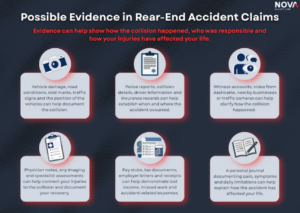
You do not need all of this before calling a lawyer. A legal team can tell you what matters and help fill the gaps.
How Much Is Rear-End Accident Claim Worth?
There is no standard settlement amount for a rear-end collision – the value of a personal injury claim depends on the nature of the injuries, the extent of the losses and the evidence available.
Because each case is different, it is important to have the full circumstances and available evidence considered before estimating what a claim may be worth.
Talk to a Corner Brook Rear-End Accident Lawyer
NOVA Injury Law helps injured drivers and passengers in Newfoundland and Labrador. We deal with the insurance companies, protect your deadlines, and fight for the full value of your claim.
Contact us today for a free, no-obligation consultation. We will assess your case, explain your options, and help you through each step of your claim while advocating for the best outcome for your circumstances.


