



 (902)442-8853
 CALL US
 EMAIL US

The challenges arising from chronic pain affect more than just your physical health – living with chronic pain can impact your social life, ability to work, independence in day-to-day activities, and more. You may also face financial strain from medical treatment, missed work, or assisted care.
When these obstacles begin to affect your finances and quality of life, you may start questioning whether you are entitled to compensation and how much your claim could be worth. There is no fixed amount awarded in Canada simply because a person has been diagnosed with chronic pain. Rather, the value of a personal injury claim depends on the unique circumstances of each case.
Below, we examine how chronic pain claims are valued, the evidence used to assess them, and the types of compensation that may be available, using case law for real-life examples.
When Does an Injury Become Chronic Pain?
Chronic pain is pain that continues beyond the expected recovery period or becomes a persistent condition following an injury, and is usually classified as such after three months of continuous symptoms.
Chronic pain can develop after many types of accidents, including:
- Motor vehicle accidents;
- Slip and fall accidents;
- Workplace accidents; and
- Sports and recreational injuries.
Some common injuries and conditions that can result in chronic pain include:
- Whiplash;
- Chronic back and neck pain;
- Joint and musculoskeletal injuries;
- Nerve pain;
- Chronic headaches;
- Fibromyalgia; and
- Complex regional pain syndrome (CRPS).
Chronic pain may also be accompanied by fatigue, sleep problems, reduced mobility, headaches or psychological symptoms. In some cases, diagnostic testing may not show an obvious physical irregularity even though the person continues to experience significant symptoms – this is where other types of evidence become valuable for a claim, which we will expand on below.
What Damages Can Be Included in a Chronic Pain Claim?
Depending on the circumstances, several different types of damages* may form part of a chronic pain claim. Because chronic pain generally continues for an extended period of time, compensation may address both losses that have already occurred and losses that are reasonably expected to continue into the future.
Pain and Suffering
General damages, sometimes called non-pecuniary damages, compensate for losses that cannot be measured simply through financial calculations. Pain and suffering can be just as or more difficult to face than quantifiable financial setbacks, thus general damage awards exist to rectify those losses. Examples of pain and suffering rewards may include:
- Physical pain and discomfort tied to the injury;
- Loss of enjoyment of life, such as,
- limitations on exercise and recreation;
- Effects on family, relationships and social activities;
- Reduced ability to participate in hobbies or leisure activities; and
- Emotional and psychological effects associated with the injury.
In motor vehicle claims, provincial legislation can also affect the amount recoverable for pain and suffering. Nova Scotia, New Brunswick, and Prince Edward Island have statutory caps for qualifying minor injuries, while Newfoundland and Labrador uses a statutory deductible rather than a minor-injury cap.
Whether ongoing pain falls within or outside these rules depends on the applicable legislation and the medical and functional evidence; the fact that pain has continued for more than three months does not automatically remove an injury from a minor-injury regime.
Loss of Income and Earning Capacity
Chronic pain can affect your ability to work even when you remain employed. This can look like reduced work hours, position changes, the need for more frequent breaks, avoiding physical tasks, or leaving a job entirely if you can no longer perform the required work.
A claim may therefore involve both past income loss and, where supported by the evidence, compensation for reduced future earning capacity. The calculation of income loss and any applicable statutory deductions can vary depending on the province and type of claim.
Medical and Rehabilitation Expenses
Treatment costs may also form part of a claim. Depending on the circumstances, this can include expenses associated with medical treatment, physiotherapy, rehabilitation, medication and other recommended care.
Where chronic pain is expected to continue, medical evidence about reasonably necessary future treatment and care needs may also support a claim for future care costs.
Other Financial Losses
An injury can affect more than medical expenses and employment. Depending on the circumstances, a claim may include reasonable accident-related expenses, loss of the ability to perform household services the injured person previously handled, and, in appropriate cases, compensation relating to care or assistance provided by family members or others to complete these tasks.
*Damages, in the context of personal injury law, are financial awards claimed to monetarily compensate for losses caused by another party’s legally actionable conduct. They can include both financial losses and non-financial losses such as pain, suffering, and loss of enjoyment of life.
Case Law: How Previous Court Awards Inform Chronic Pain Claims
Previous court decisions can provide useful reference points when assessing the value of a chronic pain claim. Courts may compare the nature and duration of an injury, prognosis, functional limitations, ability to work, treatment history, and effect on daily life with previous, similar cases.
A previous award does not establish a fixed amount for someone with a similar diagnosis, though it may contribute to the overall evaluation of your claim. Each case is assessed on its own evidence, and older awards must also be considered in the context of inflation and more recent case law.
In Hollett v. Yeager, 2014 NSSC 207, the plaintiff was 34 when he was injured in a 2006 motor vehicle accident. Although medical experts agreed that his original back injury had resolved within about two years, he continued to report disabling chronic pain seven years later. The court found that his ongoing pain affected his ability to work, but did not accept that he was completely unemployable.
- The court awarded $47,500 for non-pecuniary general damages, $201,000 for past income loss, $200,000 for loss of future earning capacity, $5,000 for loss of valuable services, $35,000 for future medication and treatment, and $3,500 in special damages for personal property damaged in the accident. Aside from special damages, all awards were reduced by 20% because the court found that his failure to pursue recommended treatment had contributed to his ongoing condition.
- Hollett is an important example of the duty to mitigate. An injured person is generally expected to take reasonable steps to recover and reduce their losses. A failure to follow reasonable treatment recommendations can reduce damages where the evidence establishes that the failure contributed to the continuation or severity of the person’s losses. This goes to show why legal teams may stress the importance of following your treatment plan.
In Lownds v. Sperker, 2014 NSSC 405, the plaintiff suffered a Grade 3 shoulder separation in a skiing collision. He experienced significant pain during the initial recovery period, but his injury had almost completely resolved by the time of trial. He did not have the continuing discomfort or emotional problems associated with a persistently troubling injury, and his prognosis was for a full return to his previous level of physical activity.
- Importantly, the plaintiff’s negligence action was ultimately dismissed because the court did not find the defendant liable. The court nevertheless provisionally assessed the damages that would have been awarded otherwise: $22,000 in general damages for non-pecuniary loss, and $2,000 for the assistance provided by his wife during his recovery. This case shows us how the duration of an injury impacts the total value of your claim. Although the initial injury was severe, the claimant reached an almost complete recovery. As a result, there was no basis for damages associated with long-term pain, future treatment, or continuing functional impairment.
The differences between these cases demonstrate how duration, severity, prognosis, functional limitations, treatment history, and the consequences of an injury can affect the assessment of damages. These cases also help us to distinguish non-pecuniary damages from the total value of a personal injury claim. An award for pain and suffering may be only one component.
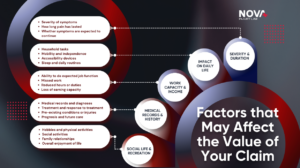
What Evidence Is Used to Establish the Value of a Chronic Pain Claim?
Evidence is particularly important in chronic pain cases. Medical records can help establish when symptoms began, how they progressed, what treatment was recommended, and whether the symptoms are consistent over time. Opinions from treating physicians, specialists and other healthcare professionals may also address diagnosis, prognosis, functional limitations, and future treatment needs.
Other evidence for the purpose of evaluating your claim may include:
- Employment and income records;
- Treatment and rehabilitation records;
- Prescription medication receipts;
- Evidence of missed work;
- Records of ongoing or future care needs; and
- Statements from the injured person or others describing changes to work, household activities, recreation, family life, and other daily activities.
Keeping a record of how your symptoms affect your daily life can help provide specific examples of how chronic pain limits your usual activities, and can contribute to the overall valuation of your claim. Ultimately, chronic pain claims are generally strongest when the medical evidence, treatment history, work records, and evidence about day-to-day functioning together provide a reasonably consistent picture of the effects of the injury.
Final Thoughts: Understanding Chronic Pain Claims and the Next Steps Forward
There is no single answer to the question, “How much is my chronic pain claim worth?” The value of a personal injury claim depends on the overall effect of the injury, and varies significantly from person to person.
At NOVA Injury Law, our personal injury lawyers can provide a full case evaluation to help determine whether you may have a claim for compensation. Our approach includes looking at the full impact of your injury, rather than focusing only on the initial diagnosis.
If chronic pain has continued after an accident and is affecting your work or everyday life, getting legal advice can help you to navigate a claim and maximize the value for your losses. Contact NOVA Injury Law today for a free, no-obligation consultation, our team is available 24/7!