



 (902)442-8853
 CALL US
 EMAIL US

Social media has become an innate part of most Canadians daily life. Whether to connect with friends, to keep people in the know about your life, for business, or simply entertainment. Of course, this doesn’t end after an injury – an accident that affects your ability to work may not affect your social life the same way. Maintaining a sense of normalcy in other aspects of life during recovery is important, and should not be faulted.
The catch is that as a claimant, insurance companies will investigate publicly accessible information to ensure the validity of your injury. Commonly, insurance companies will use anything they can to limit your compensation, or outright deny your claim.
It is best to be mindful about your social media presence if you are pursuing injury-related insurance. Posting attending a social event may seem harmless, but can be used against you to question the integrity of your claim.
Can Insurance Companies Really Review Social Media During an Injury Claim?
Yes, insurance companies often conduct investigations as part of the claims process, and this typically involves gathering information from multiple sources to assess the validity and extent of an injury. Traditionally, this included medical records, employment details, and, in some cases, surveillance.
While the above actions still occur, investigation methods have expanded to monitoring digital habits. Insurers may review publicly available online content, including social media profiles, posts, photos, and videos. This information can be used to compare a claimant’s reported limitations with their documented activities.
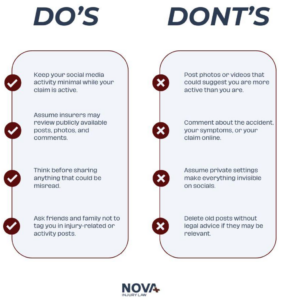
Avoid These Common Social Media Mistakes After an Accident
Why Social Media Has Become Part of Injury Investigations
The growth of social media has led to more people documenting their daily lives online. This includes sharing personal updates, activities, and events that may indirectly reflect physical or cognitive abilities. For insurers, this is simply more information that can be used as evidence to dispute your reported condition.
Public posts are already accessible to anyone. You may think that posting social media content under private privacy settings is a foolproof way to prevent the content from being used against you, but it may still become relevant to the claim further down the road through sharing, tagging, or legal disclosure.
As a result, online activity is increasingly viewed as a potential source of evidence in claims.
Cases Commonly Involving Review By Insurers
Social media review is more common in cases where the severity or impact of an injury claimed by the injured person is disputed by the insurer.
This commonly includes in cases such as:
- Motor vehicle collision claims;
- Slip and fall accidents;
- Long-term disability claims;
- Serious injury claims; and
- Claims with ongoing or fluctuating symptoms.
What Social Media Content Can Raise Questions About an Injury Claim?
Not all social media activity will affect a claim. Posting your morning tea likely won’t raise an eyebrow for insurance companies.
However, certain types of content may draw attention if they depict actions or activities that appear inconsistent with the reported injuries or disabilities. In many cases, the issue is not the content itself, but how it is interpreted without full context. Some examples of content insurers may use to question the extent of your injury or to dispute your claim include:
- Photos and videos showing physical activity
- Status updates and casual comments
- Check-ins, tags and posts from other people
- Old posts and reused content
How Insurance Companies May Try to Use Social Media Against a Claim
Insurance companies do not usually rely on social media by itself. Instead, they use it to support a broader argument that the claimant’s reported limitations may not match their observed behaviour. The goal is often to identify inconsistencies, question credibility, or suggest that the injury is less severe than claimed.
- Building a narrative: one common approach is to compare online activity with the claimant’s statements about pain, mobility, fatigue, or recovery. A post showing travel, social activity, dancing, or exercise may be framed as evidence that the claimant can do more than reported. Even if the post captures only a brief moment, insurers may use it to suggest that the overall claim is overstated.
- Challenging consistency over time: insurers may also look for patterns rather than isolated posts. A single image might not be decisive, but repeated content showing a level of activity inconsistent with the claim can be used to argue that the claimant’s reported limitations are unreliable. This is especially true where the online activity appears to conflict with medical restrictions or treatment progress.
- Framing posts as credibility problems: social media can be used to attack credibility when there is a mismatch between online statements and claim-related evidence. For example, if a claimant says they are unable to work or participate in normal activities, but posts suggest the opposite, the insurer may argue that the claimant is exaggerating symptoms or withholding information. This can hurt the claimant’s credibility in front of a judge and make them look like a less reliable source of accurate information.
- Reinterpreting casual comments as admissions: Insurers may also take casual or joking language and present it as if it were a factual admission. A comment about “feeling better,” “getting back to normal,” or “finally being active again” may be used to support the insurer’s version of events when taken out of context, even when the statement was informal, temporary, or not meant literally.
- Using third party content: Content posted by friends, family, or the claimant’s other social contacts can also be used strategically. Tagged photos, event check-ins, and group images may help insurers build a picture of the claimant’s activities, even if the claimant did not publish the content themselves. This can make online material feel more authoritative than it really is.
A few factors to help contextualise:
Photos Can Be Misleading
Symptoms such as pain, dizziness, or cognitive impairment are not visible. This can make it difficult to accurately assess a person’s condition based on images alone. You may be encouraged to engage in light physical activity as part of your recovery. These factors shouldn’t be measured by a post with little to no explanation. We understand that a single photo can not paint a whole picture, that context is everything. Unfortunately, this is not how insurance companies generally view such evidence.
Humour and Casual Language
Online communication often relies on informal language, including exaggeration and sarcasm. While this is common in everyday interactions, it can lead to misunderstandings when content is reviewed in a legal context. Statements intended as jokes may be interpreted literally, and casual expressions may be taken as factual representations.
Old Content and Deleted Posts
Deleting content after a claim has begun can raise concerns. It may be interpreted as an attempt to deliberately hide relevant evidence, which can complicate the claim and lead to further scrutiny. This applies to both content before your injury and after.
How Does This Affect Me If My Socials Are Private?
Many people assume that privacy settings fully protect their social media content. While these settings can limit access, they do not guarantee complete privacy. Public posts remain accessible to anyone, including investigators. Even private content may be shared by others or captured through screenshots. Tagged content can also appear outside your immediate control.
In legal proceedings, relevant information may be subject to disclosure. Courts may require the production of social media content if it is considered relevant to the issues in dispute. This means that private posts may still become accessible in certain circumstances. It’s better to err on the side of caution.
Case Studies Involving Social Media Use During an Injury Claim
Morabito v. DiLorenzo, 2011
In Morabito v. DiLorenzo, the Ontario court considered Facebook photographs as part of the evidence in a personal injury claim. The images and posts before and after the injury were used to assess the plaintiff’s claimed limitations and whether the online material aligned with the rest of the evidence.
- What we learn from this:
This case shows that social media evidence does not need to be dramatic to matter. Even ordinary-looking photos can be reviewed alongside medical and factual evidence, especially if they appear inconsistent with the claimed injury. It also reinforces the idea that courts may look beyond the post itself and consider the broader context before drawing conclusions.
Isacov v. Schwartzberg, 2018
In Isacov v. Schwartzberg, the claimant reported severe injury after a car accident, claiming it left her foot permanently injured. Photos from a private Instagram account belonging to a friend revealed the claimant wearing heels after her injury. This case led the Ontario Superior Court to consider social media content as part of the evidentiary record in assessing credibility and damages for this case.
- What we learn from this:
This case highlights that social media can affect more than just the injury analysis itself. It may also influence how a claimant’s credibility is viewed, which can affect the outcome of a damages assessment. The lesson is not that social media automatically harms a claim, but that online activity can become significant when it appears to conflict with other evidence.
Final Thoughts
Social media is a routine part of modern life, but it can take on added significance during an injury or disability claim. Insurance companies may review publicly available content as part of their investigation, particularly when assessing the nature and extent of a claimant’s limitations.
Posts and images do not always reflect the full context of your condition. A single moment can be interpreted in ways that differ from your reality. Understanding how social media may be viewed in this context can help individuals make more informed decisions about what they share online.
For more questions about your personal injury claim, don’t hesitate to contact us! We’re available 24/7.


